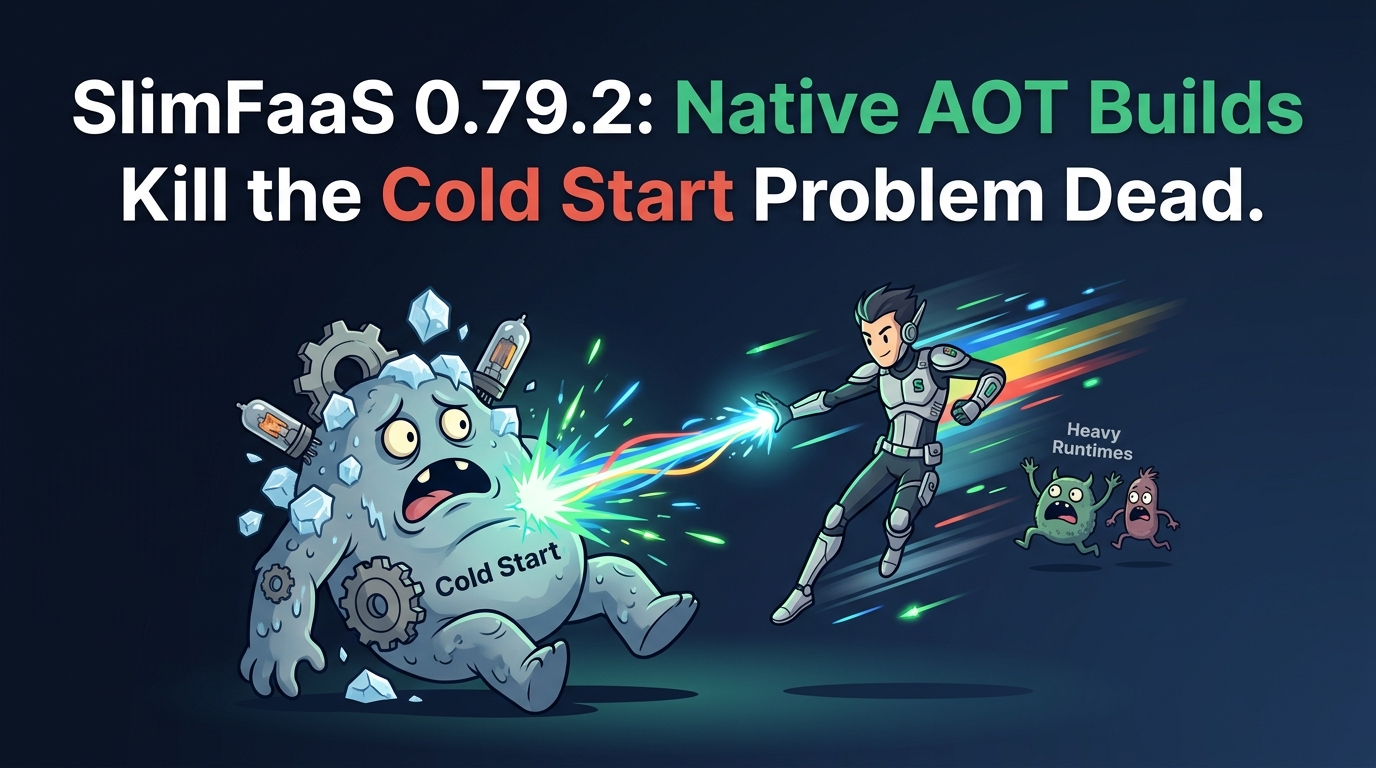

SlimFaaS, the self-described “slimmest and simplest” Function-as-a-Service platform in the CNCF sandbox, just shipped 0.79.2 — and the headline is genuinely exciting: Native AOT builds across five platforms.
That means no more .NET runtime dependencies. No more heavy container images just to run a few functions. Just a single, self-contained native binary that starts in milliseconds instead of seconds.
What is SlimFaaS? Think of it as a lightweight serverless engine that runs on Kubernetes (or Docker Compose, or Podman). You deploy functions, they scale to zero when idle, and wake up on demand from HTTP traffic, schedules, or Kafka messages. It is like AWS Lambda — except it runs on your own infrastructure, and you can actually understand the codebase.
What problem does it solve? Cold starts. The eternal nemesis of serverless. Every FaaS platform on Earth has the same problem: when a function has been idle and needs to spin up, there is a painful delay while the runtime initializes. SlimFaaS was already designed to minimize this with its autoscaling-first architecture. Now, with Native AOT, it removes the biggest remaining culprit: the runtime startup itself.
Who uses it? Platform engineers and developers who want serverless capabilities without the cloud bill, the vendor lock-in, or the 800-millisecond cold starts. Teams running edge workloads, IoT pipelines, or just trying to keep their Kubernetes clusters lean.
Why care about 0.79.2? Because Native AOT compilation is the difference between “this starts fast” and “this starts instantly.” For a platform whose entire value proposition is running functions on demand, that is not a minor optimization. It is a fundamental shift in how the system behaves.
Native AOT: Five Platforms, Zero Runtime
The core change in 0.79.2 is the introduction of Native AOT (Ahead-of-Time) builds for both SlimFaaS itself and its companion SlimFaaS MCP runtime. Here is what that actually means.
Previously, SlimFaaS required the .NET runtime to be present on the host. The runtime is a chunky dependency — it adds memory overhead, increases startup time, and expands the attack surface. With Native AOT, the .NET compiler produces a self-contained native binary. No runtime needed. No JIT compiler warming up. Just a single executable that runs.
The builds cover five platforms:
- Linux x64 — the bread and butter of Kubernetes nodes everywhere.
- Linux ARM64 — critical for AWS Graviton, Ampere, and Raspberry Pi clusters.
- Windows x64 — because not everyone lives in a pure Linux world.
- macOS x64 — for local development on Intel Macs.
- macOS ARM64 — Apple Silicon, the dominant dev laptop of 2026.
Think of it this way: old SlimFaaS was like needing to install Python before you could run a script. New SlimFaaS is a compiled binary. You download it, you run it, it works. That is the entire experience.
Faster Cold Starts
Cold starts are the defining metric of any FaaS platform. When a function has been scaled to zero and a request comes in, how long does it take to wake up and respond? With a JIT-compiled runtime, the answer includes “load the runtime, compile the code, then serve the request.” With Native AOT, the compilation step is already done. The binary is ready to go.
For SlimFaaS specifically, this matters enormously because its autoscaling-first design is built around the idea of aggressively scaling to zero. The faster you can wake functions up, the more aggressively you can scale them down — and the more resources you save. Native AOT tightens that loop dramatically.
That is the entire experience. No dotnet command. No SDK. No runtime. Just grab the binary from the release page and run it.
Lower Memory Footprint
Memory is money in Kubernetes. Every megabyte a pod consumes is a megabyte you cannot allocate to something else — and a megabyte you are paying for, whether on cloud instances or your own hardware. Native AOT binaries are dramatically smaller in memory than their JIT-compiled counterparts because they do not carry the runtime overhead.
This matters doubly for SlimFaaS because the project lists green software as one of its core topics. Less memory per function means denser packing, fewer nodes, and a smaller carbon footprint. The eco-friendly angle is not just marketing — it is a direct consequence of the architecture.
SlimFaaS MCP Goes Native Too
The release also ships Native AOT builds for SlimFaaS MCP, the companion runtime that converts OpenAPI definitions into MCP-ready tools on the fly. This is particularly interesting because MCP (Model Context Protocol) is becoming the standard way AI agents interact with external systems.
A native, lightweight MCP runtime means you can run AI tool integrations on resource-constrained environments — edge devices, CI runners, even single-board computers — without the overhead of a full runtime stack.
Under the Hood
The 0.79.2 release itself is a focused one. Beyond the AOT build pipeline, the release includes code cleanup and refactoring to ensure the codebase compiles cleanly under Native AOT constraints. AOT compilation is stricter than JIT — reflection-heavy code, dynamic loading, and certain .NET features do not work or require explicit configuration. The fact that SlimFaaS compiles cleanly as Native AOT tells you the codebase is well-structured.
The release does not introduce new user-facing features or configuration changes. The excitement is entirely in the deployment and runtime model — which, for a FaaS platform, is the feature that matters most.
Should You Upgrade?
If you are already running SlimFaaS, yes — grab the native binary for your platform from the release page. The binary is a drop-in replacement. Your existing configuration, functions, and Kubernetes manifests all work as-is.
If you have never tried SlimFaaS, this is actually a great entry point. The Native AOT builds make it easier than ever to evaluate: download a binary, run it, see if the autoscaling-first FaaS model fits your needs. No complex setup, no runtime to configure.