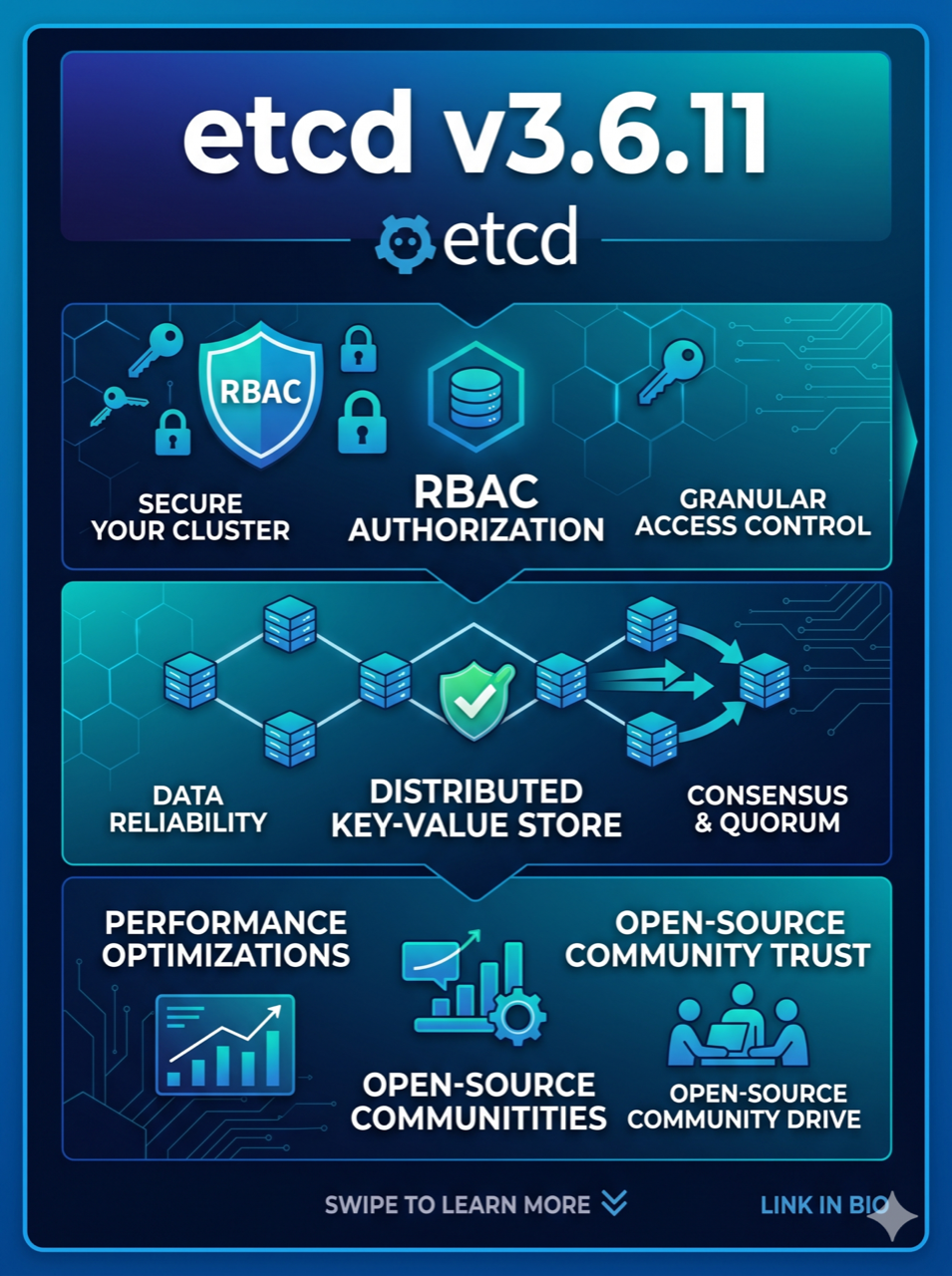
etcd just shipped v3.6.11, and while most patch releases deserve a polite nod and a quick scroll past, this one actually has something worth talking about.
etcd is the distributed key-value store that quietly runs the entire show behind Kubernetes. Think of it as the central nervous system of your cluster — it stores every configuration, every secret, every deployment decision your cluster has ever made. When etcd sneezes, Kubernetes catches a cold.
If you’ve never heard of etcd but you use Kubernetes, you’re using etcd right now. You just don’t know it. That’s kind of the point.
So what did v3.6.11 do? Two things. One of them is boring but useful. The other is the kind of thing that makes security engineers reach for the coffee.
What’s New in etcd v3.6.11
1. You Can Now Add Members When One Node Is Down
Here’s the scenario: you’re running a multi-node etcd cluster. One node goes down — maybe a disk failed, maybe a network glitch, whatever. You need to add a replacement node. Normally, etcd would say “nope” because it can’t form a quorum to approve the new member.
That’s a frustrating edge case. You’ve got quorum (the majority is still alive), but etcd’s old logic was being overly cautious. It was like a bouncer who won’t let anyone into the club because the VIP’s car is parked across the street, even though the party is going fine inside.
PR #21667 fixed this. Now etcd will let you add a new member even when one node is down, as long as quorum is still satisfied. It’s a reliability win for anyone running production clusters.
The fix: etcd PR #21667
2. A Critical Security Vulnerability Was Plugged
Okay, this is the one that matters. etcd v3.6.11 fixes a critical security vulnerability in how etcd handles authorization for certain types of requests.
Here’s what happened: etcd’s RBAC (role-based access control) layer has a job — decide who can read what. It does this pretty well. But there was a gap in how it handled Put requests nested inside etcd transactions, specifically when those requests used PrevKv (which returns the previous value before a write) or lease attachment.
In plain English: someone who had permission to write data could sneakily read data they shouldn’t be able to see. Not because they broke in. Because the authorization check took a coffee break.
This isn’t a theoretical edge case. If your etcd cluster has auth enabled and you’re using transactions with PrevKv or lease-attached Put requests (which is not uncommon in complex Kubernetes workloads), you were potentially leaking data.
The fix came in two parts:
Part 1 — Refactoring the auth check: The PR refactored how etcd validates authorization for Put requests inside transactions, making sure every code path goes through the proper check.
Part 2 — The actual fix: The second PR closed the gap by ensuring PrevKv and lease attachment in Put requests inside transactions properly respect RBAC rules.
The fixes: etcd PR #21681 and etcd PR #21685
Who Should Care?
Everyone running etcd v3.6.x with auth enabled. That’s basically every Kubernetes production cluster. The vulnerability requires auth to be enabled to be relevant (ironically, the thing that protects you was the thing that had the hole), but if you’re running etcd in production without auth, you have bigger problems.
If you’re on a managed Kubernetes service (EKS, GKE, AKS, etc.), your provider likely patches etcd separately. Check with them. But if you’re running your own etcd cluster — or if you’re using something like K3s, k0s, or microk8s — upgrade immediately.
Pro tip: Before upgrading, read the official upgrade guide. There may be breaking changes depending on your version.
How to Upgrade
etcd doesn’t need a special migration process for this release. It’s a standard patch upgrade:
# Download the new version
ETCD_VER=v3.6.11
curl -L https://storage.googleapis.com/etcd/${ETCD_VER}/etcd-${ETCD_VER}-linux-amd64.tar.gz -o /tmp/etcd-${ETCD_VER}-linux-amd64.tar.gz
tar xzvf /tmp/etcd-${ETCD_VER}-linux-amd64.tar.gz -C /tmp/etcd-download-test --strip-components=1
rm -f /tmp/etcd-${ETCD_VER}-linux-amd64.tar.gz

# Verify the version
/tmp/etcd-download-test/etcd --version
For Kubernetes clusters, this typically means rolling restart of your control plane nodes if you’re using kubeadm, or following your distro’s upgrade procedure.
The Bottom Line
etcd v3.6.11 is a patch release with a security fix that actually matters and a reliability improvement that will save someone a 3 AM page. It’s the kind of release you don’t think about until you need it — and then you’re glad it exists.
Upgrade. Verify. Sleep better.