
wasmCloud just shipped v2.6.0, and it is a big one. If you have been watching this CNCF incubating project from the sidelines, this is the release that makes you want to pull up a chair.
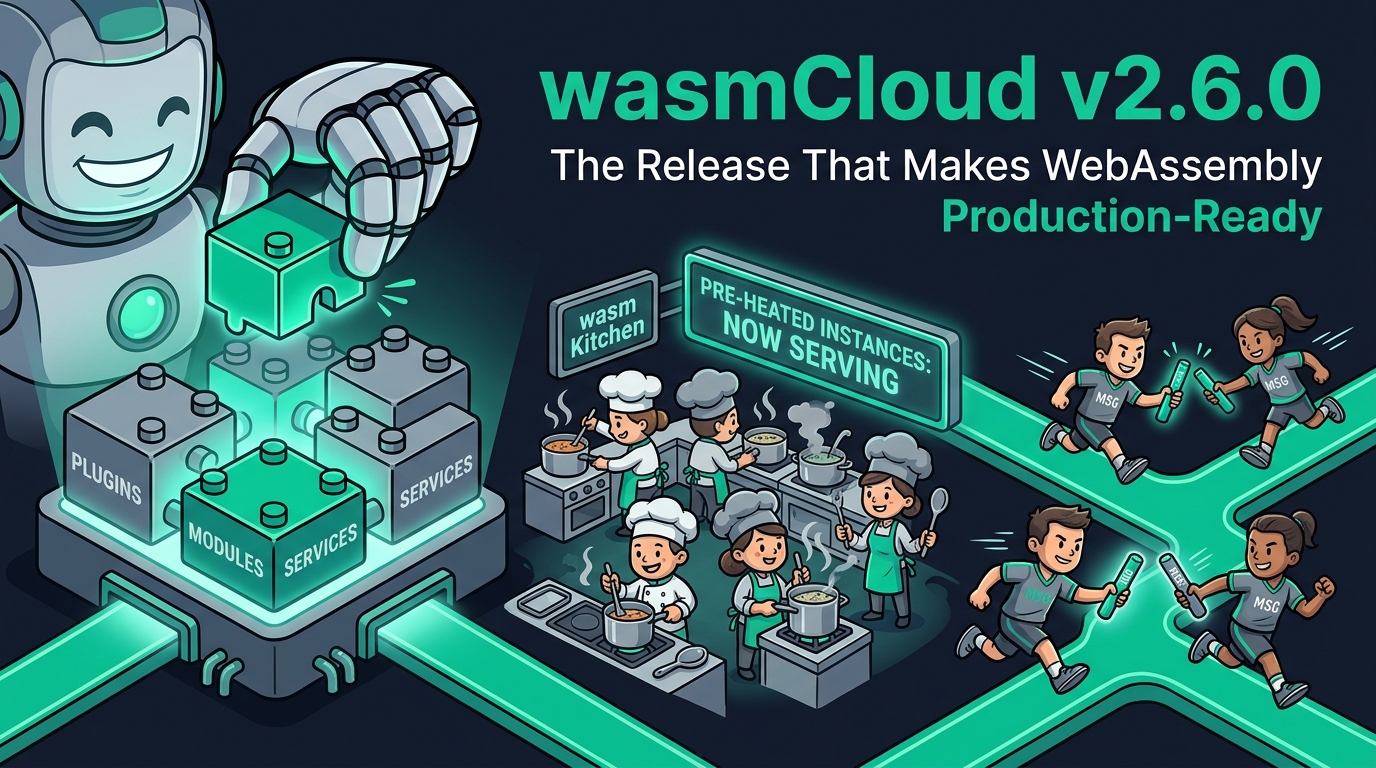
Imagine you run a restaurant. Your chefs are world-class, but every time a customer walks in, you have to hire a new chef from scratch, train them, cook the meal, then fire them when the plate goes out. That is how most serverless platforms work today. wasmCloud asks a simple question: what if your kitchen had a staff that was always ready, could cook any cuisine, and never needed to be rebuilt from scratch?
So what is wasmCloud? It is a distributed platform that runs WebAssembly (Wasm) components instead of containers. It lets you build portable, secure, lightning-fast applications that run anywhere — your laptop, a Kubernetes cluster, an edge device — without rewriting a single line of code.
What problem does it solve? Containers are heavy, cold starts are slow, and vendor lock-in is real. wasmCloud replaces all of that with lightweight Wasm modules that start in milliseconds, use almost no memory, and run the same way everywhere.
Who uses it? Platform engineers, edge computing teams, and anyone building distributed systems who is tired of the container complexity tax. If you have ever waited 30 seconds for a Kubernetes pod to scale up, wasmCloud wants to talk to you.
Why care about v2.6.0 specifically? Because this release introduces host component plugins, warm-instance pooling, trigger services with messaging ingress, and cross-store streams and futures. Together, these features transform wasmCloud from a promising runtime into something that looks an awful lot like the future of distributed application platforms. The full release is here.
What Is New
Host Component Plugins
This is the headline feature. wasmCloud v2.6.0 introduces a full plugin system for the host runtime (PR #5335). Instead of capabilities being baked into the host, you can now load, configure, and manage them dynamically.
The plugin loader (PR #5348) handles the lifecycle of each plugin, and a new plugin workload lifecycle system (PR #5381) ensures plugins are properly started and stopped. You can even configure a stop timeout via WASH_PLUGIN_STOP_TIMEOUT_SECS (PR #5377).
Why does this matter? Because it means you can extend the host with custom capabilities — custom blob stores, messaging adapters, tracing pipelines — without forking the entire project. That is how you build an ecosystem.
Host component plugins are to wasmCloud what middleware is to Express.js: a clean extension point that lets the community build capabilities the core team never imagined.
Warm-Instance Pooling
Remember the chef analogy? Warm-instance pooling (PR #5391) is what keeps the chef on staff between orders. Instead of spinning up a fresh Wasm instance for every invocation, the host now maintains a pool of pre-warmed instances that are ready to serve requests immediately.
You configure it with two new settings:
[host]
pool_size = 10
max_invocations = 1000
pool_size controls how many warm instances to keep on standby. max_invocations sets how many requests an instance handles before being recycled. This dramatically reduces latency for latency-sensitive workloads while keeping memory usage predictable.
Trigger Services with Messaging Ingress
wasmCloud v2.6.0 introduces long-lived trigger services that can receive and process inbound messages (PR #5332, PR #5333). This is a fundamental shift from the request-response model to an event-driven one.
The system can now route inbound messages to trigger services (PR #5336), with round-robin distribution across service replicas per host (PR #5374). NATS consumer groups are now used by default for message distribution (PR #5382).
In plain English: your Wasm components can now listen for events, process messages from queues, and run as long-lived services — not just one-shot handlers. This opens up stream processing, background job workers, and reactive architectures that simply were not possible before.
Cross-Store Streams and Futures
This one is for the async-minded (PR #5334). Wasm components can now create streams and futures that cross component store boundaries. Previously, async data flows between components were limited. Now, a component can hand off a stream or future to another component, enabling pipeline-style processing where data flows through multiple stages asynchronously.
Think of it like passing a baton in a relay race, except the baton is a live data stream and the runners are Wasm components.
Async Secrets and Security
The release also adds async wasmcloud:secrets along with a dedicated secrets host component plugin (PR #5395). Secrets can now be fetched asynchronously, which means your components no longer block on secrets resolution during startup. For anyone running wasmCloud in production with external secrets managers, this is a meaningful reliability improvement.
Build P3 Components and WebGPU Support
Two more additions deserve a mention:
- P3 component builds (PR #5349) — wash build now supports building P3 (Component Model Phase 3) components directly. No external toolchain required.
- wasi:webgpu 0.3.0-rc.2 (PR #5316) — WebGPU support gets a significant update, opening the door for GPU-accelerated compute workloads running in Wasm.
Performance and Runtime Improvements
Beyond the headline features, v2.6.0 includes several under-the-hood improvements:
- Wasmtime 47 upgrade (PR #5373) — the underlying runtime gets a significant version bump.
- Nagle disabled on accepted HTTP connections (PR #5363) — reduces latency on HTTP request handling.
- Workload IP name lookup (PR #5404) — workloads can now resolve each other by name.
- Duplicate workload ID rejection (PR #5379) — prevents accidental conflicts.
What’s Next
wasmCloud v2.6.0 is a statement release. Host component plugins, warm-instance pooling, trigger services, and async secrets together represent a platform that is maturing fast. If you wrote off Wasm for production workloads a year ago, it is time to look again.