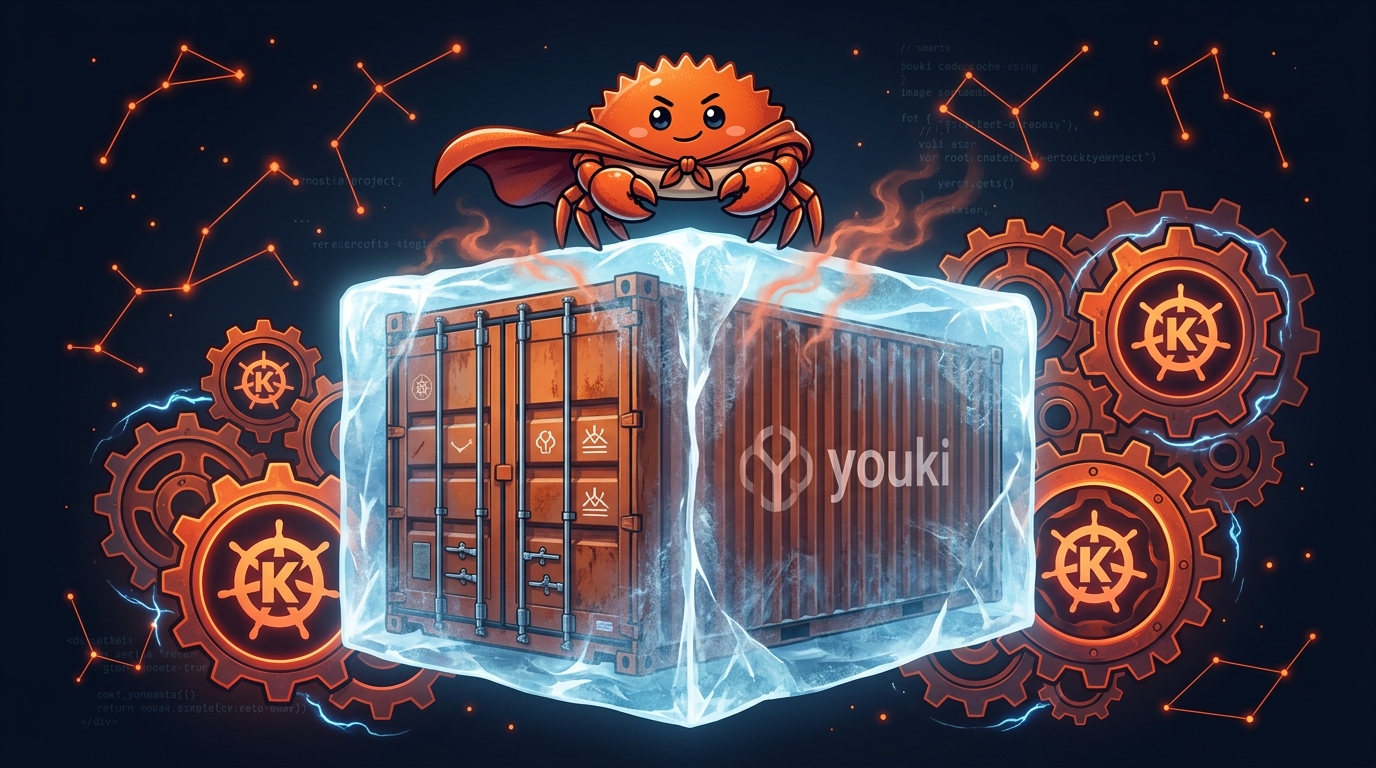

If you have ever wished that runc were written in a language that catches memory bugs at compile time instead of at 3 AM on a Saturday, you already know about youki. It is a container runtime written in Rust that implements the OCI runtime specification — the same spec that runc follows, just with a compiler that refuses to let you shoot yourself in the foot.
Youki does the same job as runc: it takes a container bundle (a root filesystem plus a config file) and turns it into a running, isolated Linux process. The difference is that youki is built in Rust, which means memory safety guarantees, zero-cost abstractions, and a concurrency model that does not require a PhD in suffering.
With v0.7.0, youki takes a massive step forward. This release adds rootless cgroup v2 support, ID-mapped mounts, a Kubernetes DaemonSet installer, time namespace support, and major improvements to container checkpoint and restore via CRIU integration. It is the kind of release that makes you think: maybe it is time to stop defaulting to runc and start taking this Rust alternative seriously.
What Is New in v0.7.0
Rootless Cgroup v2 Support
Running containers as root is the security equivalent of leaving your front door wide open with a sign that says “please do not steal anything”. Rootless containers fix this — they let unprivileged users run containers without needing root access. But rootless mode requires the container runtime to manage cgroups (the Linux kernel feature that limits and isolates resource usage) without root privileges, and that has historically been a headache.
Youki v0.7.0 adds full rootless cgroup v2 support. This means you can now run containers as a non-root user on any system running cgroup v2 (which is every modern Linux distribution). The runtime handles all the cgroup delegation magic — creating, managing, and cleaning up resource limits without ever asking for root.
# Run a container rootlessly with cgroup v2
youki run --rootless my-container
Why it matters: Rootless containers are not a nice-to-have. They are the future of container security. Every container that runs without root is one less privilege escalation path for an attacker. PR #3609
ID-Mapped Mounts
Have you ever mounted a volume into a container, only to discover that all the files are owned by root (UID 0) on the host but nobody (UID 65534) inside the container — or worse, the reverse? This is the UID/GID mismatch problem, and it has been making container users miserable since the dawn of namespaces.
Youki v0.7.0 introduces ID-mapped mount support. This is a Linux kernel feature that lets you remap user and group IDs at the mount point level. Instead of running a separate chown on every file (slow and error-prone), the kernel transparently translates UIDs as files are read and written.
# ID-mapped mount in an OCI spec
{
  "mounts": [
    {
      "destination": "/data",
      "source": "/host/data",
      "type": "bind",
      "options": ["rbind", "rw", "idmap=uids=0_1000_10000;gids=0_1000_10000"]
    }
  ]
}
The feature also includes spec validation, ensuring invalid mappings are caught before the container ever starts. PR #3409 and PR #3572
Kubernetes DaemonSet Installer (youki-deploy)
Installing a custom container runtime across a Kubernetes cluster has traditionally been a choose-your-own-adventure book where every page ends with “now SSH into every node and run this manually.” Youki v0.7.0 ships a DaemonSet-based installer that handles this declaratively.
The new youki-deploy component uses a Kubernetes DaemonSet to install youki on every node in your cluster automatically. No SSH. No Ansible. No shell scripts held together with hope.
# Deploy youki across your entire cluster
kubectl apply -f youki-deploy-daemonset.yaml
Why it matters: This is the feature that lowers the barrier from “interesting Rust experiment” to “I can actually run this in production.” Managing container runtimes at fleet scale just got a lot less painful. PR #3526
Time Namespace Support
Containers share the host’s clock. This is usually fine — until you need to test how your application behaves at 3 AM on New Year’s Eve, or you want to run a legacy application that expects a different system time. Previously, the only option was to manipulate the clock inside the container, which often broke things in surprising ways.
Youki v0.7.0 adds support for time namespaces, a Linux kernel feature that gives each container its own independent clock offset. The container sees a different time than the host, without affecting any other process on the system.
# Time namespace in a container spec
{
  "namespaces": [
    {"type": "time"}
  ]
}
Why it matters: Time travel is no longer science fiction for containerized workloads. This is especially useful for CI pipelines, snapshot testing, and legacy migration scenarios. PR #3550
Checkpoint and Restore Gets Serious
Container checkpoint and restore is the ability to freeze a running container, save its entire state to disk, and then resume it later — potentially on a completely different machine. It is powered by CRIU (Checkpoint/Restore In Userspace), and youki v0.7.0 brings a wave of improvements to this capability:
- CRIU version validation — youki now checks that the installed CRIU version is compatible before attempting a checkpoint. No more silent failures from version mismatches. PR #3438
- External namespace registration — external namespaces are now properly registered with CRIU, improving restore fidelity for complex container configurations. PR #3495
- Container state cleanup — when checkpointing without
--leave-running, youki now properly cleans up container state, preventing zombie entries from lingering in the state directory. PR #3501 - Checkpoint mode management — the
--manage-cgroup-modeoption gives you explicit control over how cgroups are handled during checkpoint. PR #3452 - Link remapping — the
--link-remapoption ensures hard links are properly tracked during checkpoint, preventing data corruption on restore. PR #3618
Checkpoint and restore is the feature that makes container migration, live snapshots, and fast cold-starts possible. It is the kind of capability that separates a toy runtime from a production-grade one.
Init Container Builder API
For developers embedding youki as a library (rather than using it as a CLI), v0.7.0 adds a with_bundle() builder method for configuring init containers programmatically. This makes it easier to construct complex container configurations in Rust code without manually serializing JSON specs.
Bug Fixes and Polish
The release also includes over 20 bug fixes that improve runc compatibility and address edge cases in mount handling, cgroup management, and seccomp rule evaluation. Notable fixes include:
- Duplicate mount entries on exec — running
execinside a container no longer creates phantom mount entries. PR #3432 - Seccomp multi-condition rules — multi-condition seccomp rules now follow the same logic as runc, preventing rule evaluation mismatches. PR #3489
- Bind mount detection — bind mount detection is now based on the
bind/rbindoptions rather than the filesystem type, fixing edge cases with overlay mounts. PR #3611 - Memory swap calculation —
MemorySwapMaxis now correctly set to 0 whenmemory.limitequalsmemory.swap, preventing unexpected OOM kills. PR #3488 - PID limit floor — when
pids-limitis set to 0, youki now changes it to 1 instead of allowing a fully unlimited process count. PR #3634
Sixteen New Contributors
This release welcomed 16 new contributors to the project. For a sandbox-stage CNCF project written in Rust, that is a signal of healthy community growth. The contributors range from first-time open source participants to experienced Rust developers, and they touched everything from core runtime logic to test infrastructure.
Should You Switch?
Youki v0.7.0 is the release where the project goes from “interesting alternative” to “genuinely viable production runtime.” Rootless support, Kubernetes-native deployment, checkpoint/restore maturity, and ID-mapped mounts are not incremental improvements — they are the features that make the difference between experimenting on a Friday afternoon and running real workloads.
If you care about memory safety, supply chain security, and not getting paged at 3 AM because of a use-after-free in C, youki just gave you six more reasons to take it for a spin.