
Flux v2.9.0 just shipped, and it might be the single most feature-packed release the CNCF graduated GitOps tool has ever dropped. We are talking a brand-new CLI plugin system, post-quantum encryption for your secrets, SSH-based commit signing, workload identity for Vault and AWS CodeCommit, and that is barely scratching the surface. If you manage Kubernetes infrastructure with GitOps, this release has something that will make your Monday mornings less painful.
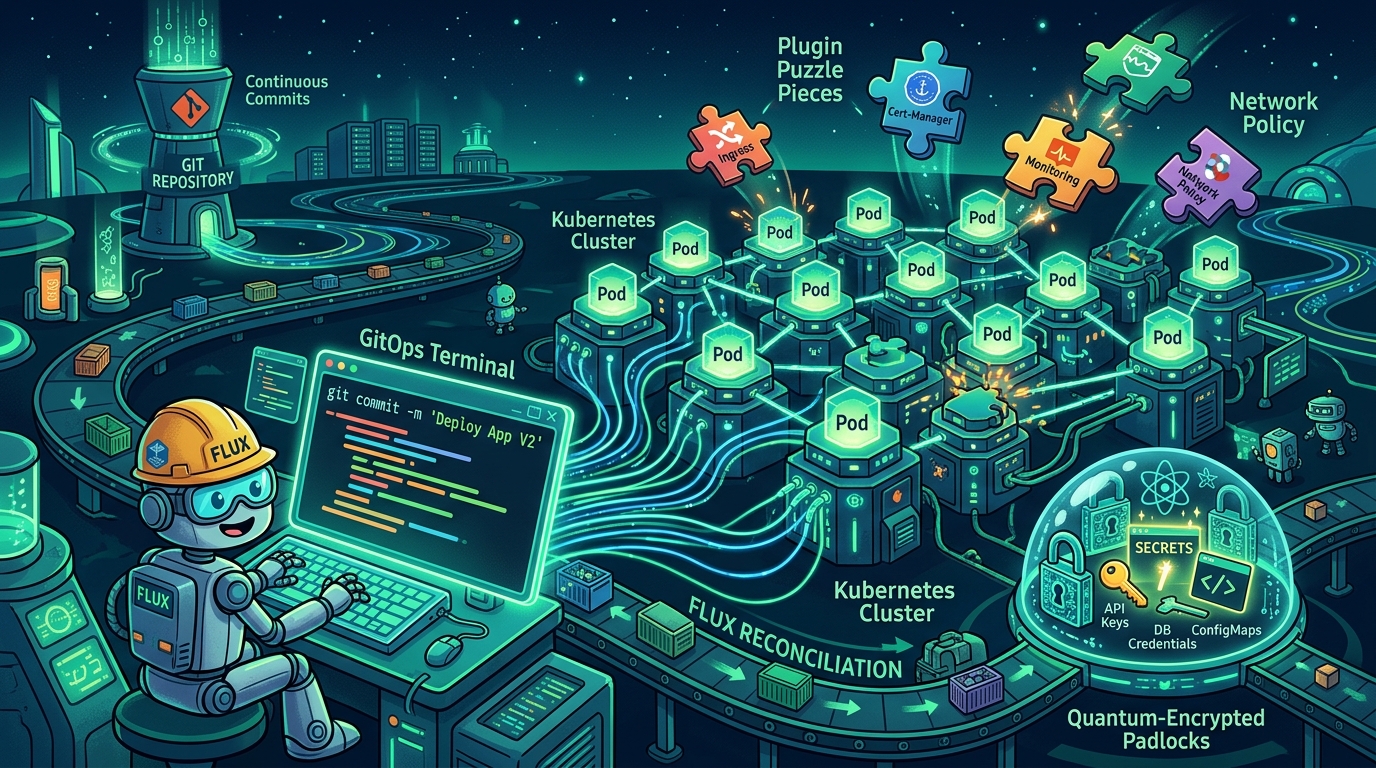
What is Flux? Think of Flux as the autopilot for your Kubernetes cluster. You describe what your infrastructure should look like in a Git repo, and Flux makes sure the running cluster matches that repo — automatically. No more manually running kubectl apply and hoping you did not forget a namespace. No more “who deployed that?” arguments in Slack. Flux watches your Git repo, detects changes, and reconciles them to your cluster. It is declarative infrastructure management done right.
What problem does it solve? Configuration drift. The slow, silent disaster where your Git repo says one thing and your cluster does something completely different because someone SSHed in and tweaked a Deployment at 2 AM. Flux catches that drift and either alerts you or automatically corrects it. It also handles the entire supply chain: pulling container images, rendering Helm charts, applying Kustomize overlays, and pushing commit-based image updates back to Git.
Who uses it? Platform engineers, SREs, and DevOps teams running Kubernetes at any scale — from startups with three nodes to enterprises managing hundreds of clusters. If you have ever looked at a Helm release and thought “there has to be a better way to manage this,” Flux is that better way.
Why care about v2.9.0 specifically? The CLI plugin system is the headline act. Flux now has an extensibility model that lets third-party plugins ship as native flux subcommands. But if plugins do not excite you, maybe post-quantum encryption for your sealed secrets will. Or workload identity for Vault, which means no more long-lived tokens sitting in your cluster. Or SSH commit signing, which finally brings keyless Git verification without GPG headaches. Pick your favorite — there are twelve new features to choose from.
What’s New in Flux v2.9.0
Flux CLI Plugin System
This is the headline feature of v2.9.0. Flux now supports a plugin architecture defined in RFC-0013 and implemented in this release. Plugins extend the flux command with additional capabilities that ship and version independently of the Flux CLI itself, but feel like native subcommands once installed.
Why this matters: Until now, every new Flux capability meant a CLI update. Want registry mirroring? Update Flux. Want manifest validation? Update Flux. The plugin system breaks that coupling. Community members and vendors can ship plugins for specialized workflows without waiting for a Flux release cycle. It turns Flux from a tool into a platform.
The plugin catalog ships with two initial plugins: Mirror (mirrors Helm charts, OCI artifacts, and container images between registries with multi-arch support and signature verification) and Schema (validates Kubernetes manifests against JSON schemas and CEL rules with built-in schemas for Kubernetes, OpenShift, Gateway API, and Flux CRDs).
# Search the catalog of available plugins
flux plugin search

# Install a plugin
flux plugin install schema

# List installed plugins
flux plugin list

# Pin to a specific version for reproducibility
flux plugin install schema@0.5.0

# Pin to an immutable digest for production
flux plugin install schema@sha256:<digest>
You can also pin plugins to immutable digests for production environments, and Flux validates plugin binary paths before execution to keep things safe.
Server-Side Apply Field Ignore Rules
This one fixes a pain point that every Flux user has hit at some point. Flux uses server-side apply to manage your resources, which makes it the field manager for everything it reconciles. But some fields are meant to be owned by other controllers — like the replicas field managed by a Horizontal Pod Autoscaler, or certificates injected by an admission webhook. Before v2.9.0, Flux would keep trying to revert those fields back to what Git said, creating an endless tug-of-war.
Now you can tell Flux to ignore specific fields. Using the new Kustomization.spec.ignore field, kustomize-controller skips designated paths during drift detection and apply:
apiVersion: kustomize.toolkit.fluxcd.io/v1
kind: Kustomization
metadata:
  name: podinfo
  namespace: flux-system
spec:
  # ...
  ignore:
    - target:
        kind: Deployment
      paths:
        - "/spec/replicas"
Why this matters: This is the kind of feature that makes you wonder how you ever lived without it. If you run HPA, service mesh sidecar injection, cert-manager, or any controller that mutates live objects, this ends the drift noise once and for all. You can also see ignore rules in flux diff kustomization output now.
SOPS Decryption with Post-Quantum Cipher
The future of encryption is quantum-resistant, and Flux is getting ahead of it. v2.9.0 adds support for decrypting SOPS-encrypted secrets sealed with the Age post-quantum cipher. This means your secrets at rest are protected by encryption that can resist attacks from quantum computers — while keeping the same SOPS-based GitOps workflow you already use.
Why this matters: Post-quantum cryptography is not science fiction anymore. NIST finalized its post-quantum standards in 2024, and the clock is ticking on when current RSA and elliptic curve encryption becomes breakable. Flux adopting the Age post-quantum cipher means your sealed secrets workflow is future-proofed without any workflow changes.
Workload Identity for OpenBao and Vault
No more long-lived Vault tokens in your cluster. Starting with v2.9.0, kustomize-controller can authenticate to OpenBao and HashiCorp Vault using Kubernetes Workload Identity. Flux exchanges the controller’s ServiceAccount token for Vault credentials — following the same keyless authentication model already used for cloud providers.
Why this matters: Static Vault tokens stored as Kubernetes Secrets are a security liability. They do not rotate, they can be leaked, and they have overly broad permissions. Workload Identity gives Flux short-lived, scoped credentials that are automatically rotated. It is the difference between leaving your house key under the mat and having a smart lock that generates a new code every hour.
Helm Post-Render Strategies
Helm users, this one needs your attention. v2.9.0 adds support for Helm post-render strategies in the HelmRelease API, giving you control over how post-rendering interacts with chart hooks.
Breaking change heads-up: The default post-render strategy has changed from nohooks to combined. With the new default, Helm hooks are included in the post-rendering process, which more closely matches Helm’s native behavior. If your charts depend on the previous behavior, set the strategy explicitly to nohooks on your HelmReleases before upgrading.
Why this matters: Post-rendering is how teams inject labels, annotations, and other modifications into rendered Helm templates before they hit the cluster. The strategy control means you can finally get predictable behavior when chart hooks are involved, which has been a source of subtle bugs for anyone doing complex Helm post-processing.
More Good Stuff
The release is packed with additional capabilities that deserve a mention:
- Literal mode for Helm values — The HelmRelease
valuesFromfield now supports a literal mode that mirrorshelm install --set-literal. Pass whole config files (think Java.propertiesor YAML blobs) into a chart value without Helm trying to parse dots as nested objects. - Empty kind in CEL health checks — CEL-based health check expressions now allow an empty kind, so you can write checks that apply across multiple resource kinds in both HelmReleases and Kustomizations.
- Git commit signing with SSH keys — Source-controller can now verify Git commit signatures made with SSH keys, complementing existing GPG support. The image-automation-controller can also sign commits with SSH keys, and so can flux bootstrap.
- AWS CodeCommit via Workload Identity — Flux can now authenticate to AWS CodeCommit using Workload Identity, extending the keyless auth model to AWS-hosted Git repos. You can bootstrap Flux directly onto CodeCommit.
- Custom Sigstore trusted root — For air-gapped environments, source-controller now supports a custom Sigstore trusted root for keyless verification of OCI artifacts, so organizations running their own Sigstore infrastructure can verify signatures without relying on the public trust root.
- Monorepo path pattern discovery — The ArtifactGenerator API gains path pattern directory discovery, so instead of declaring an artifact per app by hand, you describe a directory layout with patterns and let source-watcher auto-discover matching directories and generate artifacts.
- Secret-less OIDC Receivers — Webhook Receivers can now be secured with OIDC instead of shared secrets. No more HMAC tokens to rotate. There is also a new
flux trigger receivercommand for triggering webhooks from CI without crafting HTTP requests yourself.
Upgrade Notes
Two APIs have been removed: image.toolkit.fluxcd.io/v1beta2 and notification.toolkit.fluxcd.io/v1beta2 have reached end-of-life and are gone from the CRDs. Before upgrading, migrate all resources to the stable APIs using the flux migrate command.
CVE-2026-40109: GCR Receivers now require the email and audience fields in their referenced Secret. If you use GCR-based Receivers, update your Secret before upgrading.
Helm post-render default changed: From nohooks to combined. Review your HelmReleases if they rely on the previous behavior.
The full upgrade guide is available at the Upgrade Procedure for Flux v2.7+ discussion.
Flux v2.9.0 is not just another release — it is twelve reasons to reconsider how you do GitOps.